


You may also like
-

Palm reading Poster
Unknown artist · 2015 · Vintage-inspired palmistry poster featuring an open hand diagrammed with intricate black lines
Poster from 223,50 Kč · Framed from 397,33 Kč
-

Diagram no.3 Poster
Hiram Erastus Butler · 1887 · Esoteric zodiac anatomy poster rendered as a crisp black and white chart
Poster from 223,50 Kč · Framed from 397,33 Kč
-
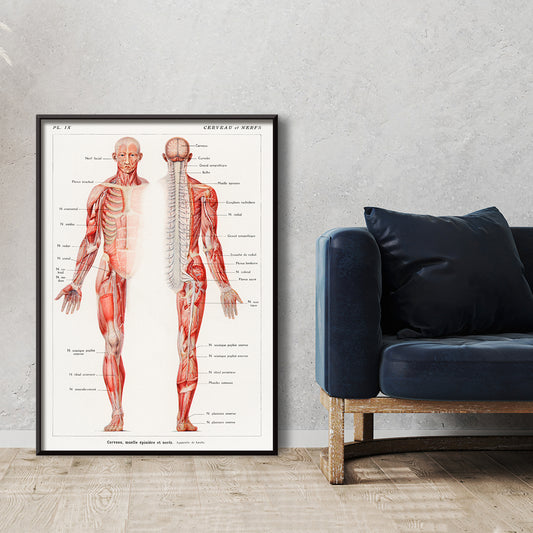
Human Nervous System Poster
Galtier-Boissière and Émile · 1912 · Detailed anatomical scientific print of the human nervous system in red on white
Poster from 223,50 Kč · Framed from 397,33 Kč
-

Voyage autour du monde 104 Poster
Louis-Isidore Duperrey · 1828 · Detailed skull anatomy scientific print arranged as comparative studies on aged paper
Poster from 223,50 Kč · Framed from 397,33 Kč


-

"Very nice Posters. The quality is amazing and we received it very quickly !"
-

"A shop to visit absolutely. Huge selection of posters. We spent more than an hour there !"
-

"Perfect to find gift. Price are very good. An they can frame and pack it on site"
About the Artist
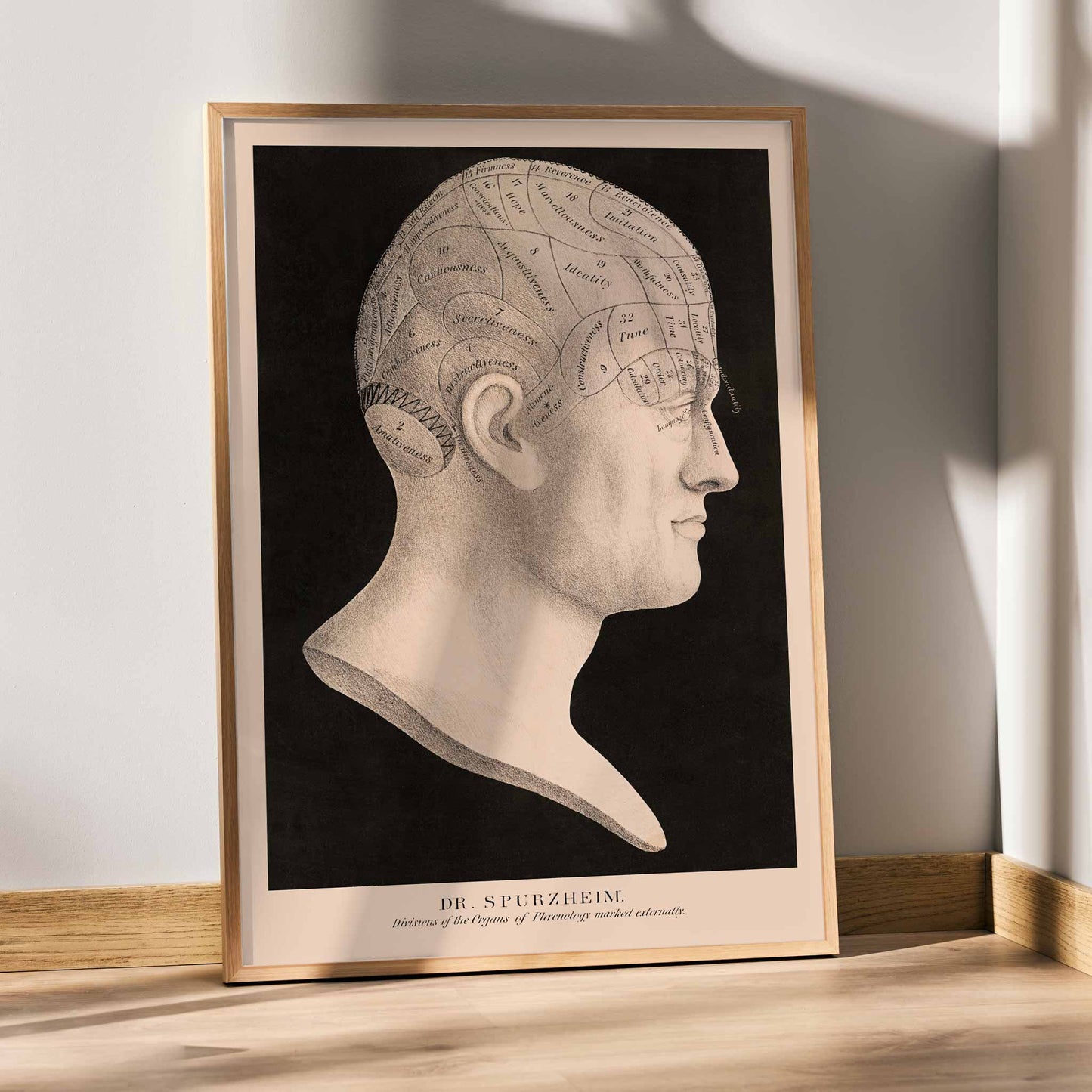
Johann Gaspar Spurzheim gives this scientific poster its direct connection to the early history of phrenology. Trained as a physician, he worked with Franz Joseph Gall before presenting his own account of the system. Public lectures carried his ideas from European audiences to Britain and the United States, where the promise of reading character through the skull attracted sustained attention. His name on this 1834 document identifies both a historical figure and a disputed medical theory, making the vintage print relevant to anyone exploring the history of science.
Spurzheim died in 1832, so this dated plate preserves his teaching shortly after his death. It functions as a historical art print rather than a reliable guide to the mind.
The Artwork
Divisions of the organs of phrenology was created as a reference for Spurzheimian thought. Its purpose was to connect supposed mental faculties with specific areas of the head, offering readers a system for interpreting character through external examination. The chart belongs to a period when printed diagrams helped medical ideas travel beyond specialist books and lecture rooms.
Modern neuroscience rejects the central claims of phrenology, which gives this vintage poster a second meaning today. It records how an unsupported theory could be presented as orderly knowledge and invites reflection on the changing boundary between medical inquiry and popular belief. As a fine art print, it preserves that intellectual history without asking the viewer to accept the theory.
Style & Characteristics
The eye meets a large right-facing profile set against a dense black field. A pale beige and grey head occupies most of the vertical poster, while numerous curved divisions map the skull like a network of small compartments. Handwritten labels follow those boundaries, and tiny numerals appear beside several terms, encouraging close inspection of the scientific print.
The face is softly modeled, with a calm expression and a clearly defined ear, nose, lips, and chin. A narrow light border surrounds the image, while compact lettering beneath the profile supplies the title and attribution. From across the room, the dark ground gives the wall art a graphic presence; nearby, the fine lines and restrained vintage print palette reward a slower look.
In Interior Design
In a book-lined study, this fine art print can hang above a walnut writing desk, where its vertical format echoes the height of the shelves. A slim black frame would reinforce the dark field and let the pale profile remain legible against the surrounding wood. The labels invite the viewer to lean closer, turning a short pause between pages into an encounter with an unusual piece of scientific wall art.
The restrained beige, grey, and black palette keeps the home decor focused on the image rather than on decoration around it. Beside the desk, the vintage poster can give the room a historical point of reference, while its subject introduces a thoughtful tension between old medical confidence and present-day knowledge. In this setting, interior decoration becomes a quiet prompt for curiosity.