




-

"Very nice Posters. The quality is amazing and we received it very quickly !"
-

"A shop to visit absolutely. Huge selection of posters. We spent more than an hour there !"
-

"Perfect to find gift. Price are very good. An they can frame and pack it on site"
About the Artist
Henri Matisse turned to painted paper and scissors when cutting became a way to draw directly in colour. His work on Jazz, published by Tériade in 1947, brought this method into an artist book of twenty plates, reproduced through pochoir stencil printing. Le Cirque opens the sequence, making the circus the first encounter with Matisse and his late cutout practice. Rather than sketch a performer and then fill the outline, he assembled an image from separate shapes. In an art print of Le Cirque, that approach retains its force: movement seems to begin where one piece of paper meets another.
The Artwork
The circus promises an event that vanishes as soon as the performers leave the ring. Matisse gave that passing spectacle a place at the beginning of Jazz, a book in which images accompany his handwritten reflections. Its title evokes improvisation, although the plates do not illustrate particular songs or performances. Le Cirque was not an advertisement for an actual show; as a vintage poster reproduction, it invites viewers into the imagined performance of the artist book. Its original setting changes the encounter with this circus image: it first asked readers to turn a page, not buy a ticket.
Style & Characteristics
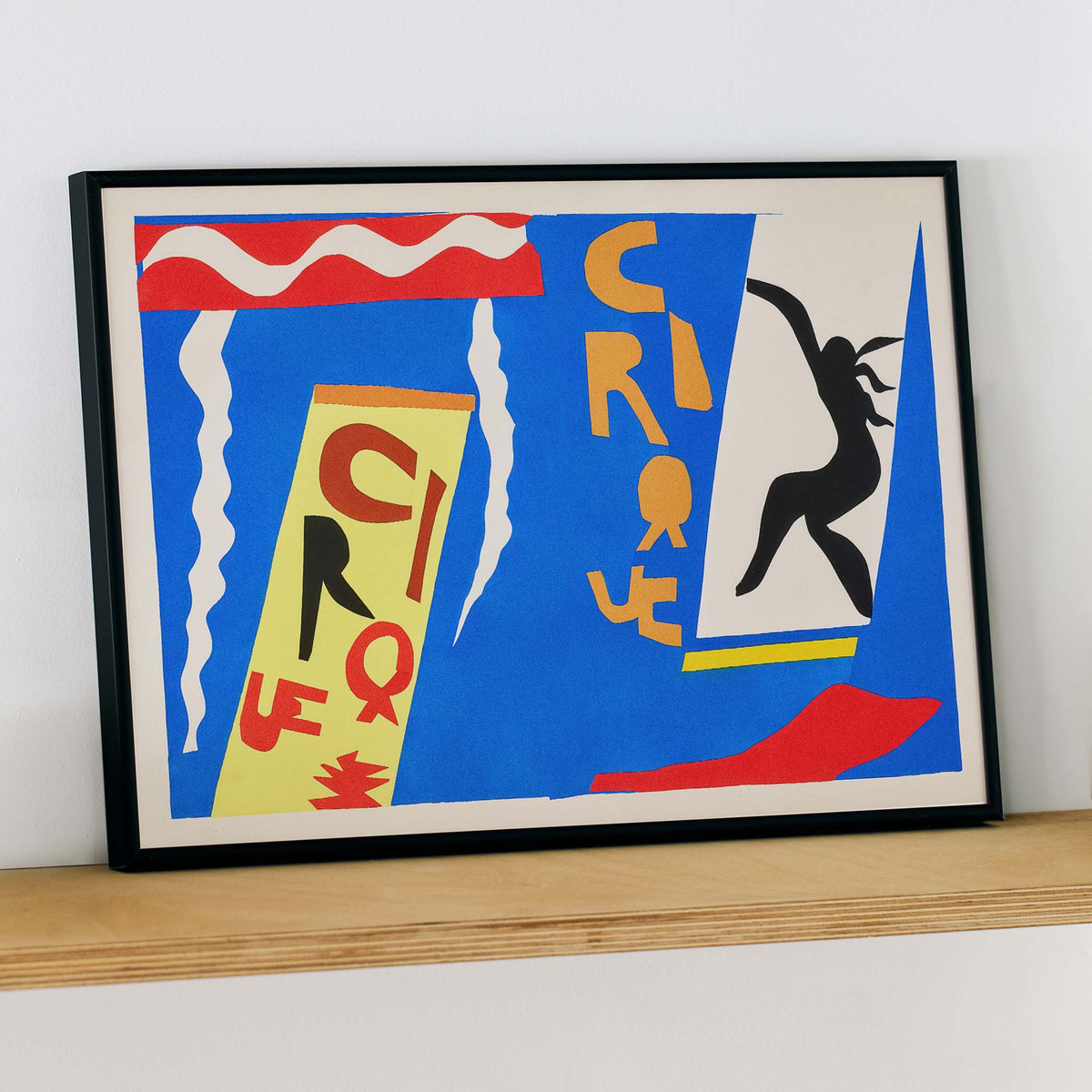
A broad blue field pulls the eye first, then the black acrobat appears inside a slanted white space at the right. The limbs jut at different angles, giving the silhouette a sense of motion. On the left, a yellow strip carries scattered letters in red and black; orange lettering falls through the blue beside it. White ribbons cross the red band overhead and descend into the scene. A red shape runs along the bottom, as if the stage continued beyond the frame. The cut-paper geometry gives this abstract wall art its motion without rendering a literal circus ring.
In Interior Design
In a sunlit sitting room, hang this horizontal poster above a low oak sideboard, where the blue expanse interrupts a quiet stretch of wall. From an armchair opposite, the black figure comes into focus after the lettering has drawn the eye across the page. A single red cushion answers the shape along the lower edge without making the rest of the home decor mimic the image. This approach to interior decoration uses one visual echo instead of matching every colour. Above the sideboard, the fine art print supplies movement while the furniture gives the eye a place to rest.