


You may also like
-

Antique map of Africa Poster
Institute of Liepzig · 1851 · Detailed Africa vintage print with gridded coordinates and dense place names
Poster from 223,50 Kč · Framed from 397,33 Kč
-

L'Afrique en 1890 Poster
Unknown artist · 1890 · Detailed Africa map poster with French labels and period boundary markings
Poster from 223,50 Kč · Framed from 397,33 Kč
-

Antique map of Brasil Poster
Institute of Leipzig · 1886 · Detailed Brasil vintage print with crisp borders and period German typography
Poster from 223,50 Kč · Framed from 397,33 Kč
-

Antique map of Italy Poster
Institute of Liepzig · 1887 · Classic Italy map poster with crisp borders, islands, and dense geographic labeling
Poster from 223,50 Kč · Framed from 397,33 Kč


-

"Very nice Posters. The quality is amazing and we received it very quickly !"
-

"A shop to visit absolutely. Huge selection of posters. We spent more than an hour there !"
-

"Perfect to find gift. Price are very good. An they can frame and pack it on site"
About the Artist
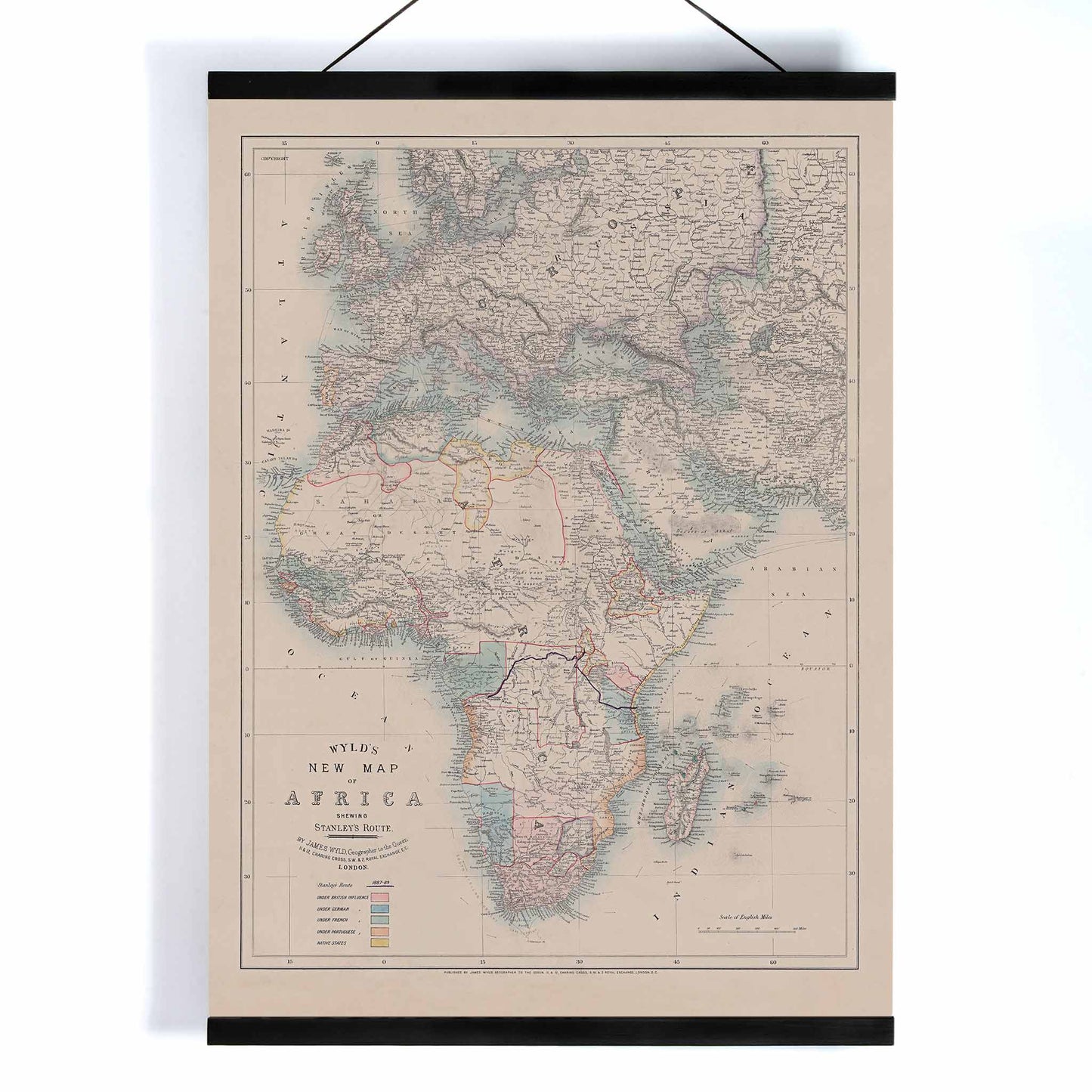
Wyld is tied to the mapmaking world of nineteenth-century London, where James Wyld built a reputation through maps sold to readers who wanted geography in a practical, handsome form. His name appears on sheets that made current borders and travel routes feel immediate in the home, and this vintage poster reflects that same commercial clarity. The print also recalls the wider life of Wyld's map business, where large-scale cartography turned information into wall art with a distinctly Victorian sense of authority.
The Artwork
New Map of Africa from 1887 captures a continent being described through late Victorian knowledge, with European place names and coastal detail shaped by the political and commercial interests of the period. The map speaks to readers who followed imperial news, shipping routes, and colonial claims, then wanted a fine art print they could study at leisure. As a vintage print, it serves as both reference and record, preserving the way Africa was framed for print audiences in the years after the Berlin Conference. Its purpose is historical as much as decorative, and that dual role gives the poster its lasting documentary weight.
Style & Characteristics
The sheet is organized around a pale beige ground, with soft blue seas and delicate washes of red and grey marking borders, coastlines, and regions. Dense lettering fills the landmass, while the frame line and title block keep the vertical poster feeling orderly and precise. The muted palette gives the map a restrained, slightly aged look that suits vintage cartography, and the fine engraved lines reward close looking. Seen as an art print, it carries the calm pressure of a page packed with detail.
In Interior Design
Place it in a study where a walnut desk and one reading lamp define the room, and the map becomes a steady point of attention on the wall. Its tall format works well beside shelving, while the paper tone and soft color notes bring quiet depth to home decor. Framed simply, this wall art adds historical character without crowding the space, and the vertical composition helps a narrow wall feel considered. In interior decoration, it gives a room a measured, intellectual presence that invites closer looking.